A “Bonus” Brief Book Summary from Books At a Glance
by Benjamin J. Montoya, PhD
Editor’s Note: We promise our members one Book Summary per week, and each year we deliver many more. This is yet another “Bonus” Book Summary on a topic of expressed interest to many.
About the Authors
Stephen Macedo is an American political scientist who serves as the Laurance S. Rockefeller Professor of Politics at Princeton University, where he was the former director at the University Center for Human Values.
Frances E. Lee, an American political scientist, is currently a professor of politics and public affairs at the Princeton School of Public and International Affairs at Princeton University
Introduction
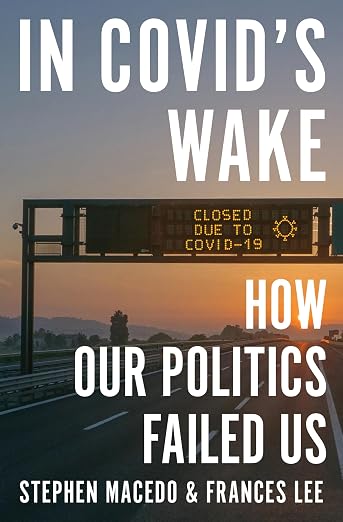
The political and global atmosphere of March 2020 when COVD essentially shut-down the world is probably something we will never forget; but, when we consider how this matter was handled politically, we must ask how well we did politically? Our politics failed us in several key ways despite having plans in place for such a scenario.
Editorial Note: There are several charts in this book that could not be duplicated here. These charts enhance the value of the book considerably.
Table of Contents
Chapter 1 Democracy under Covid: Introduction
Chapter 2 “Following the Science” before Covid
Chapter 3 Turning on a Dime: Embracing China’s Covid Model
Chapter 4 Partisan Pandemic: Stigmatizing Disagreement
Chapter 5 Laboratories of Democracy?
Chapter 6 Pay Any Price: Ignoring the Costs of Covid Policy
Chapter 7 Science Bends to Politics: Covid’s Muddled Origins
Chapter 8 Politicized Science: Of Masks and Mandates
Chapter 9 Noble Lies? Public Health Mis- and Disinformation under Covid
Chapter 10 Concluding Reflections: Learning from the Politics of Crisis
Summary
Chapter 1: Democracy under Covid: Introduction
How did democracy perform under Covid? Did it continue to function as planned? Or did it fail? Or was it somewhere in between? Instead of continuing to function as a democratic society, blue states and those who supported the claims of “specialists” basically ruled. If someone did not agree with them, they were shunned and silenced. That is not democracy; that is a form of socialism, at best.
Thinking back to these time periods may truly be an uncomfortable feeling for most because the world felt like it stopped, but it is important to consider failures of this nature to learn more to improve as a society and to fix this kind of toxicity that could ruin our public life as a nation. The goal, however, is not to engage in some kind of academic finger-pointing placing blame game; the purpose is to outline our shortcomings as a nation to chart a better way forward. These kinds of situations could easily happen again.
Chapter 2: “Following the Science” before Covid
The resounding collective conclusions before Covid all said the same thing about non-pharmaceutical interventions (NPIs) in response to Covid. These include lockdowns, social-distancing, preemptive school closures, mass testing, and contact tracing. Dr. Anthony Fauci was quoted as follows:
That’s something that I don’t think we could possibly do in the United States, I can’t imagine shutting down New York or Los Angeles, but the judgment on the part of the Chinese health authorities is that . . . this is something that in fact is going to help in containing it. . .Whether or not it does or does not is really open to question because historically when you shut things down it doesn’t have a major effect.
Presidents, state authorities, and the collective group of health organizations, various studies, etc., all point to these same conclusions. Plans for how to respond to pandemics had been a topic for discussion since prior pandemics, and all these plans had the same conclusions regarding the utility of NPIs. Yet, as soon as the pandemic hit, things went in the opposite direction, even from those who had expressed skepticism before 2020; some of the same people entirely reversed course and embraced lockdowns and school closures. What they did not consider, however, is the ongoing costs and uncertain benefits of these decisions. . . .
[To continue reading this summary, please see below....]The remainder of this article is premium content. Become a member to continue reading.
Already have an account? Sign In