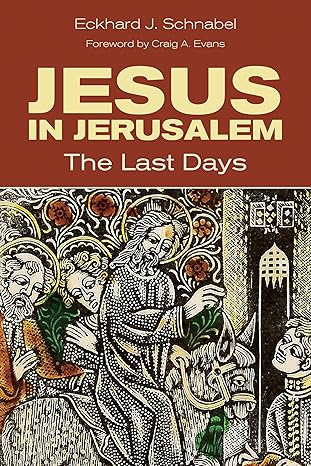
A Brief Book Notice from Books At a Glance
Even a brief glance through the Table of Contents (see below) shows this book to be an invaluable resource, describing and analyzing, sequentially and in detail, all the persons, places, times, and events mentioned in the Gospel accounts of Jesus’ last week in Jerusalem.
Part reference guide, part theological exploration, Eckhard Schnabel’s Jesus in Jerusalem uses the biblical text and recent archaeological evidence to find meaning in Jesus’ final days on earth. Schnabel profiles the seventy-two people and groups and the seventeen geographic locations named in the four passion narratives. Placing the events of Jesus’ last days in chronological order, he unpacks their theological significance, finding that Jesus’ passion, death, and resurrection can be understood historically as well as from a faith perspective.
“Must have” reading for all who teach or preach from the passion narratives of the New Testament Gospels.
D.A. Carson writes about this book:
Many have undertaken to write about Jesus’ last days in Jerusalem, but few have done so with Schnabel’s magisterial command of the sources, both Jewish and Greco-Roman, or with his knowledge of the secondary literature. Despite the erudition packed into this work, the writing is straightforward and clear. This is a volume for everyone who claims to be interested in the passion of Jesus—for skeptics and the devout alike, for academics and pastors. No one will be able to engage this literature in the future without weighing the careful and detailed work of Eckhard Schnabel.
Table of Contents
Introduction
1. People
1. Jesus.
2. The Twelve.
3. The Eleven.
4. Two Unnamed Disciples.
5. Simon Peter.
6. Andrew.
7. James son of Zebedee.
8. John son of Zebedee.
9. Thomas.
10. Philip.
11. Judas son of James.
12. Judas Iscariot.
13. Nathanael.
14. Lazarus.
15. Simon the Leper.
16. Cleopas.
17. Nicodemus.
18. Joseph of Arimathea.
19. Unnamed Disciple from Emmaus.
20. Two Anonymous Disciples.
21. Owner of a Colt in Bethphage.
22. Man with Water Jar in Jerusalem.
23. Owner of House in Jerusalem.
24. Young Man in Gethsemane.
25. Women Disciples.
26. Martha from Bethany.
27. Mary from Bethany.
28. Mary the Mother of Jesus.
29. Mary the Wife of Clopas.
30. Mary from Magdala.
31. Mary the Mother of James and Joseph.
32. Mother of James and John.
33. Salome.
34. Joanna.
35. Acquaintances of Jesus.
36. Pilgrims.
37. Crowds.
38. Tax Collectors.
39. Prostitutes.
40. Vendors, Customers, and Moneychangers on the Temple Mount.
41. Blind and Lame.
42. Children.
43. Gentiles/Greeks.
44. Rich People.
45. Widow.
46. Members of the Sanhedrin.
47. Chief Priests.
48. Sadducees.
49. Experts of the Law.
50. Lay Aristocrats.
51. Pharisees.
52. Annas. Former High Priest.
53. Caiaphas. High Priest.
54. Malchus. Slave of Caiaphas.
55. Malchus’s Relative.
56. Two Female Slaves of Caiaphas.
57. Retainers.
58. Officers of the Jewish Executive.
59. Jewish Security Forces and Their Captain.
60. Witnesses.
61. Herodians.
62. Herod Antipas.
63. Soldiers of Herod Antipas.
64. Pontius Pilate.
65. Pontius Pilate’s Wife.
66. Soldiers of Auxiliary Troops.
67. Centurion.
68. Barabbas.
69. Simon of Cyrene.
70. Women of Jerusalem.
71. Two Criminals.
72. Man with Sponge at Golgotha.
2. Places
1. Jerusalem.
2. Temple Mount.
3. Mount of Olives.
4. Bethany.
5. Bethphage.
6. Gethsemane.
7. Akeldama.
8. House of Jesus’ Last Supper.
2. Residence of Annas.
10. Residence of Caiaphas.
11. The Sanhedrin Building.
12. Praetorium.
13. The Lithostrotos.
14. Residence of Herod Antipas.
15. Golgotha.
16. Jesus’ Tomb.
17. Emmaus.
3. Timelines
1. The Year AD 30.
2. Saturday-Sunday. Nisan 9 (April 2- 3).
3. Sunday-Monday. Nisan 10 (April 3-4).
4. Monday-Tuesday. Nisan 11 (April 4-2.
5. Tuesday-Wednesday, Nisan 12 (April 5-6).
6. Wednesday-Thursday. Nisan 13 (April 6- 7).
7. Thursday-Friday. Nisan 14 (April 7- 8).
8. Friday-Saturday. Nisan 15 (April8- 9).
9. Saturday-Sunday. Nisan 16 (April 9-10).
10. Saturday-Sunday, Nisan 23 (April16-17).
4. Events
1. The Anointing in Bethany.
2. Jesus’ Approach to Jerusalem.
3. Jesus’ Prophetic Action on the Temple Mount.
4. The Jewish Authorities’ Scheme to Eliminate Jesus.
5. The Lesson of the Withered Fig Tree.
6. Controversies and Jesus’ Public Teaching on the Temple Mount.
7. The Greeks Seek Jesus and the Unbelief of the People.
8. The Jewish Authorities’ Planning of Jesus’ Arrest.
9. The Betrayal by Judas Iscariot.
10. Prophecy of the Destruction of Jerusalem, of the End, and of His Return.
11. Preparations for Passover.
12. The Last Supper in Jerusalem.
13. Arrest in Gethsemane.
14. Preliminary Interrogation before Annas and Peter’s First Denial.
15. The Trial before the Sanhedrin with Caiaphas Presiding and Peter’s Denials.
16. Transfer of Jesus’ Case to Pontius Pilate.
17. The Trial before the Roman Prefect with Pontius Pilate Presiding.
18. The Walk to Golgotha.
19. Jesus’ Crucifixion.
20. Jesus’ Burial.
21. The Death of Judas Iscariot.
22. The Guards at the Tomb.
23. The Empty Tomb and Jesus’ Appearance to the Women.
24. Jesus’ Appearances to the Disciples.
5. Significance
1. Jesus Is the Messiah. the King of the Jews.
2. Jesus and the Temple.
3. Jesus’ Death.
4. Jesus’ Resurrection.
5. Jesus’ Mission and the Mission of His Followers.
Bibliography
Index ofAuthors
Index of Subjects
Index of Scripture References
Index of Other Ancient Writings
From the Foreword by Craig Evans
Professor Eckhard Schnabel, Mary F. Rockefeller Professor of New Testament at Gordan-Conwell Theological Seminary, has emerged as one of the world’s foremost New Testament scholars….
This book … is lengthy, learned, and filled with useful information and sound judgment. No stone is left unturned in this remarkable book, which focuses on Passion Week, from Palm Sunday, when Jesus entered Jerusalem, to Easter Sunday, when Jesus was resurrected. Professor Schnabel considers what can be known of some seventy-two persons and groups, starting with Jesus and the Twelve and concluding with the named and unnamed men and women who in one way or another were involved in the crucifixion. He reviews no fewer than seventeen villages and places where events took place. Of the events themselves Professor Schnabel identifies and discusses twenty-four. Ten different aspects of chronology and timelines are also examined. Nothing of importance is omitted.
Professor Schnabel brings this excellent study to a conclusion by addressing the significance of his findings, which are summed up under five headings: the messianic identity of Jesus, Jesus and the temple, the death of Jesus, the resurrection of Jesus, and Jesus’ mission and the mission of his followers. By probing the significance of these topics Professor Schnabel does what historians are supposed to do: He establishes the factual data as best as possible and then looks for the meaning of these data.
The result is a truly stimulating and satisfying study. Every reader will be impressed by the depth of learning reflected in this comprehensive, encyclopedic book. To write an informed and edifying account of Jesus’ final week in Jerusalem, one needs to know a great number of ancient texts, preserved in several languages, as well as the geography and topography of first-century Israel, the relevant archaeological discoveries, and an almost endless number of publications in several modern languages. Professor Schnabel demonstrates throughout that he has control of these complex subdisciplines and that he has what it takes to sift it carefully and present a satisfying and illuminating study of what many will agree was the most important week in human history.