A Book Review for Books At a Glance
by Ryan M. McGraw
Christians often struggle to follow a unified thread throughout the entire Bible. Somewhat ironically, doing so is both easy and hard at the same time. It is easy in the sense that the unified voice in which various biblical authors advance the same story under the same God is breathtaking. Yet it is hard with respect to knowing which big picture details we should latch onto that will simplify a large amount of detail spanning over a thousand years of writing and writers.
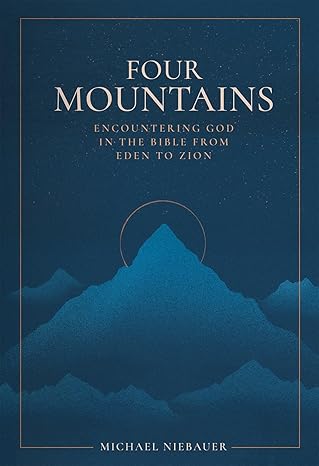
This book offers a delightful angle on telling the Bible’s story, relying both on narrative and symbolism. Niebauer’s main narrative junctures are Mount Eden, Mount Sinai, Mount Tabor, and Mount Zion, corresponding to the Garden, Abraham through David, with Moses’ mountain-top experience as a climactic moment, Jesus’s transfiguration as a foretaste of his second coming, and Mount Zion as the heavenly Jerusalem and marriage supper in which we participate in and reject Christ’s glory. Four Mountains itself forms a compelling narrative that is both easy to read and hard to put down. Gathering some of the best material from the early church, he draws readers from creation and fall, through partial (but cloudy) restoration under Moses, to the glory of Christ as the centerpiece of the Christian life, landing in the fulfillment of Christian hope in glory, showing us how to gain glimpses along the way on earth.
The amount of attention given to critique in this review could be misleading, given how helpful and compelling most of the material is. My review thesis is that readers should take up and enjoy Four Mountains while being aware of some of its limitations and pitfalls. Among other things, its strengths lie in the author’s extensive use of the (oft neglected) transfiguration and in his exposing readers to the devotional writings of the early church. Its weaknesses lie in raising an inordinate number of controversial doctrinal issues.
Story and symbol are the primary vehicles through which Niebauer unfolds the Bible. While many of picked up biblical content via narrative, he contends that symbols in Scripture are the binding agents of the Bible – they bind the individual books of the Bible together, and they bind those books to Jesus, and finally, they bind Jesus to the reader” (3). While he provides a useful charter sketching some of the primary symbolism in the Bible (14), his main symbols are mountains where God revealed himself to his people at crucial points. Specifically, he singles out Mount Eden, Mount Sinai, Mount Tabor, and Mount Zion, around which he revolves the rest of the biblical narrative in twenty-one chapters. Rather than supplanting alternative ways of reading the unified message of Scripture (like covenants, which he omits), he seeks to complement rather than supplant other excellent approaches (9). Regarding Eden, he notes that many readers miss that Eden was a mountain rather than flat because a great river ran down from the mountain, splitting into four others (35). The purpose of Eden was to be a place with God where mankind had a home, harmony, work, and worship. While, curiously, skipping Noah and the flood following mankind’s fall into sin, he includes some great insights in these five chapters, such as, “The tower of Babel was a man-made mountain modelled after Eden” (70), showing how Babel inverted Eden at every point.
Just as part one stretched beyond Eden through the fall and up to the tower of Babel, so part two (chapters 6-10) encompasses Abraham through the prophets. Chapter eight treats Moses’ encounter with God on Mount Sinai proper as a kind of pivot for the entire section. While the mountain and tabernacle, with its rituals, clearly point a way back to God and to Eden, this relationship was limited and partial “in veil and cloud” (131). This veil is removed fully only in Christ. Thus, revolving around the mount of transfiguration (Mount Tabor), the four chapters in part three take readers through four movements in the life of Christ: descent, ascent, crucifixion, and resurrection. The transfiguration, fixed on Christ’s deity shining through his humanity, is a superb focal point for unfolding the New Testament. Believers gain glimpses of Christ’s return and glory, and hope of the beatific vision, in what they see from the vantage point of Mount Tabor. Niebauer states profoundly, “As the Old Testament Tabernacle was a portable Mount Sinai, the New Testament church is the portable Mount Tabor, the place where people encounter God’s glory in the person of Jesus Christ” (240). Christians must learn from Mount Eden and Mount Sinai, but where they live fundamentally is in moving from Mount Tabor to Mount Zion (e.g., 329), namely, heaven and resurrection. These metaphors have the advantage of heightening the importance of the church in salvation, and giving the worship of the church an eschatological bent, moving from glimpses of the beatific vision to its full unveiled glory. This creates a heavenly bent to Christian worship as believers gather on the Lord’s Day expecting to glimpse God’s glory in Christ.
Part four then focuses on the path Christians walk to the heavenly Mount Zion, from Christ’s ascension and Pentecost, through private devotion, public worship, Scripture, and preparing for death (chapters 15-21). On Mount Zion, home, harmony, work, and worship will be restored (e.g., 241, 261). Starting with chapter eighteen, “prayer and church life” are central to the final chapters of the book (280). Moving from private spiritual disciplines, into church life, then to the Bible, he concludes in chapter twenty-one with our final “climb up Mount Nebo” in preparing for death. Niebauer describes an Anglican worship service from the Book of Common Prayer as his example, though aiming to make his example applicable to Roman Catholics, Eastern Orthodox, and Protestants at large (301). While this includes elements foreign to many Protestant services, such as “the smoke of candles or incense fills our nostrils” (303), and “the passing of the peace” (304), most of this chapter revolves around the Word, sacraments, and prayer. He includes some excellent statements challenging us to rethink the importance of the sacraments in the Christian life. For instance, “In baptism, heaven and earth come together in water” (281). And the Lord’s Supper brings “past, present, and future together” (326), as we “enter into sacred time” in communion with the risen Christ. Chapter twenty not only recaps how Christians should search for God primarily in reading Scripture (329), but revises the common Christian practice of habituating our minds to remember the teachings of Scripture as we interact daily with the natural world (333-339). Appreciating nature without depreciating Scripture is a pervasive theme throughout the book, fostering devotion to God in all of life. The opening page in chapter twenty sums up this entire project well: “This book has only scratched the surface of the enormous depth and endless riches of the Bible. There are hundreds of stories and countless mountains that have not been discussed” (317). Yet Eden, Sinai, Tabor, and Zion are well-chosen, giving readers key hermeneutical patterns that will help them read the Bible better, looking for the Triune God on every page.
One of the great strengths of this book is Niebauer’s heavy reliance on the early church fathers. By and large, modern Protestant readers are unfamiliar with the writings of the fathers, and they excelled best when applying biblical symbolism, such as the four mountains theme. Sometimes this introduces speculative ideas such as the notion Adam and Eve would have moved from childhood with the Tree of the Knowledge of Good and Evil to adulthood with the Tree of Life (38), and that their sin was eating the first tree at the wrong time (39). Most of the time, however, his citations help readers recover once common, but now long-forgotten, biblical parallels. For instance, citing Abraham’s victory over his enemies and meeting Melchizedek (Gen. 14:13-24), he notes that the themes of victory, bread and wine, and tithing carry over into the New Testament: “Just as fresh bread and fine wine are partaken of at wedding banquets on Saturdays, each Sunday Christians around the world gather together to celebrate the victory of Jesus over evil, bringing bread, wine, and a tenth of their earnings to the alter as they sin praises to God Most High” (87). Whatever readers think about such parallels, gaining some familiarity with early church devotion and exegesis stretches sanctified imagination in learning to make broad connections to Christ and the church throughout Scripture.
Alongside the many compelling features of this book, readers should know what they are getting themselves into in relation to what this reviewer sees as some unnecessary controversies and deficiencies. For instance, Niebauer says in passing that in creating human beings, God “risked the possibility that they might choose to reject his love” (27). Yet the biblical God “risks” nothing, being undisturbed in blessedness and sovereignty (1 Tim. 6:15). Niebauer also appears to teach a kind of limbus partum, in which none of the Old Testament saints entered heaven until the actual death and resurrection of Christ. He notes that Jesus was “the first human being to enter heaven” (221). Immediately following, he adds, “As the first human in heaven, Jesus continues his mission of saving mankind” (222). One wonders what this means for Moses and Elijah, both of whom appeared on Mount Tabor with Jesus, and the saints in “Abraham’s bosom (Lk. 16:22).
Some controversial points arise in relation to worship as well. For instance, he commends John of Damascus on making images of Christ (211), building on his otherwise helpful theme of God ministering to us both in body and soul. Yet the early church universally rejected images of Christ, and the whole Trinity for that matter, until gradually making an official u-turn on its policies by commending the veneration of icons at the Second Council of Nicaea in 787. Sometimes, Niebauer sounds like he teaches baptismal regeneration, or at least full purity and remission of sins at baptism (273). Likewise, his view of the Lord’s Supper often sounds something like transubstantiation. Though seeking to avoid controversy over the manner of Christ presence in the sacrament (355, note 2), his language elsewhere certainly goes beyond spiritual communion with Christ’s physical body and blood through the Holy Spirit. For instance, the bread and the wine “become the sacrificed body and blood of Christ” (128). Though often overstated, he, nevertheless, makes moves Protestants toward a more positive view of the sacraments, such as when he says, “In baptism, heaven and earth come together in water” (281). Sometimes in over-reaction, Protestants rejecting baptismal regeneration and Christ’s physical presence in the Lord’s Supper can undervalue the sacraments as vehicles through which Christ comes to us and we to him in the Spirit. While culling out some of his material, readers will find his high view of the sacraments positively challenging in other respects.
Perhaps more troubling, he also refers to receiving “a vision of Jesus on the cross” on a mountain when he was fifteen (238). Later, he adds that people come to Christ in different ways, some of them “through an unexpected vision of Jesus” (281). As a case in point, he reminds readers, “my faith was cemented by a vision of Jesus on the side of a mountain as a teenager” (282). He also mentions “my friend Jon…frequently receives dreams and visions from God,” which he likens to the (far less frequent!) dreams and visions in the Book of Acts (321). Yet many people have been deceived by supposed visions, signs, and wonders, often driving them to trust their experiences for assurance, whether or not their faith and life agrees with Scripture. Deuteronomy 13:3-4 offers a chilling evaluation of over-reliance on signs or wonders that “come to pass” (v. 2, NJKJV), adding, “for the Lord your God is testing you to know whether you love the Lord your God with all your heart and with all your soul. You shall walk after the Lord your God and fear Him, and keep His commandments and obey His voice; you shall serve Him and hold fast to Him.” In Scripture, miraculous visions either predated Scripture, as in the case of Abraham, or certified prophets, apostles, and churches planted by them. Jesus also consistently subordinated the works he did to the words that he spoke (Jn. 14:11). While healing a nobleman’s son at Capernaum, he chided the crowd saying, “Unless you people see signs and wonders, you will by no means believe” (Jn. 4:48). The challenge with appealing to a vision of Jesus on a mountain is that many claiming similar visions use them as an invincible guard for false doctrine and bad lives. Scripture consistently offers Isaiah’s counsel: “To the law and to the testimony! If they do not speak according to this word, it is because there is no light in them” (Is. 8:20). Such episodes somewhat mar an otherwise beautiful portrait of the Bible’s story.
Lastly, almost in passing, he states that “We are not called to speculate about the eternal well-being of those who do not know Christ, but instead to proclaim the good news that Jesus is risen and gift to them the opportunity to receive eternal joy and the certainty of salvation” (258). Though we might sympathize with such compassionate agnosticism, Scripture is clear that unbelievers are “without Christ,…strangers from the covenants of promise, having no hope and without God in the world” (Eph. 2:12), and that God pours out his wrath on those “who do not know God, and on those who do not obey the gospel of our Lord Jesus Christ” (2 Thess. 1:8). Because these realities are the impetus behind preaching the Word to all people (Rom. 10:14-17), Niebauer’s plea for evangelism come off as weak; unbelievers could be actually well-off, but we can only help them become more well-off.
Four Mountains offers a beautiful depiction of the biblical narrative, hinging on life with God. Its narrative is readable, gripping, imaginative, and steeped in some of the best insights the early church had to offer about communion with God. The book could have been more useful in dropping so many controverted doctrinal and practical issues, omitting which would not have detracted from its overall value. Prayerfully discerning readers, with Bibles open, will nonetheless discover some rich gems in this mine, as they learn to look back from Jesus’s transfiguration toward the blessed sight of the Triune God in heaven.
Ryan McGraw
Greenville Presbyterian Theological Seminary